12.12.2017

Zambia: Local Volunteers Supporting Mobile Health Clinics

 
To save pregnant women and their babies in medically remote areas in Zambia, it is necessary to detect abnormalities or other dangerous signs at an early stage, provide first aid, and send pateients to an appropriate medical center as promptly as possible. Because there are not enough medical workers in  villages dotted across the vast country, local volunteers in these communities play an important role in assisting mobile clinics operated by midwives sent by the Ministry of Health, Zambia. AAR Japan, which has been running a project to protect maternal and child health in Chisankane, Kafue District since February 2016, gave local volunteers a training seminar for maternal and child health from October 31st to November 5th, 2017.  

Training Seminar for Maternal and Child Health   

A total of 50 volunteers were initially selected from among 100 local volunteers as a “group for the promotion of safe delivery.” Then, 25 group members took part in  AAR Japan’s first training seminar for maternal and child health. These members were selected with consideration of a mixture of different hometowns and trust relationships between volunteers and communities. The aim of the training is to have local volunteers acquire knowledge and skills for maternal and child health, including recognizing dangerous signs during pregnancy, as well as providing information on breastfeeding benefits and how to check and treat illness in newborns.


                          Role-playing an actual situation, role-playing exercises were carried out 
                        on November 4th, 2017. The left is Daisuke KANAMORI from AAR Japan.

As some local volunteers cannot read or write, the training adopts role-playing exercises with picture cards so that everybody can easily understand the lessons. For example, assuming a postpartum bleeding situation, volunteers learned procedures from giving first aid for stopping bleeding and promoting adequate hydration, to sending the patient to a medical center. Participants also practiced how to place the pregnant woman in order to wrap a cloth as a temporary treatment, following their instructor’s direction. The volunteers have committed themselves fully for the training.
Other training incorporated the benefits of using five senses such as singing, dancing and gesturing with traditional songs in Zambia. These attempts   also help illiterate participants learn and remember the lessons more easily. In the last day of the training session, we carried out a skill test to check their understanding. As a result, all of the participants successfully completed the training, getting much higher scores than those for the preliminary test carried out on the first day. 

                                                Test for treatment of postpartum bleeding


                Training materials include lots of pictures and illustrations for illiterate volunteers.


                                        Local volunteers listening to lectures with serious eyes.

The group members for the promotion of safe delivery in Chisankane will play important roles for recognizing and analyzing issues specific to their areas of responsibility, and for finding solutions for maternal and child health challenges. One of training participants, Mr. Mutonji, expressed his enthusiasm; “I didn’t know what to do when a pregnant woman or her baby was in a critical condition. This training taught me how to treat them. In my village, I’ll definitely share what I have learned here so that we can help more mothers and babies. “

AAR Japan will continue to hold training sessions for maternal and child health, and working on protection of mothers and babies in cooperation with local volunteers.
.
In addition to public donations, this activity has been subsidized by the Grant Assistance for Japanese NGO Projects by MOFA

Reporter
Daisuke KANAMORI, Lusaka Office since November 2016 
 Born in Yamaguchi, Japan. After graduating from university, he joined support activities for Tohoku earthquake affected areas while working in a private company. Then, he studied the reconstruction after the civil war in Rwanda at a graduate course in U.K and then learned French in France. He joined AAR Japan with an aspiration of doing something he can do in this society as a Japanese. He hopes to improve rates of the high maternal and neonatal mortality in Zambia. He enjoys playing football and futsal games. (Profile as of the date of the article)

Translated by: Ms. Satomi Tomishima
Proof reading by: Mr. Allan Richarz

9.12.2017

The Great East Earthquake: Victims living in different situations mutually support each other

Disaster victims from Fukushima prefecture had a pleasant time on the Sunday afternoon of September 10th, in Musashino, Tokyo. They had evacuated from Fukushima and are taking shelter in and around the city. It was “Musashino Smile,” an organization which supports the evacuees, that organized the gathering, with assistance from AAR Japan. A total of 28 people participated. Junnko Matsuo, the person who organized the gathering, said, “It is difficult for some of the victims to attend a weekday party, so I planned a holiday lunch party so that more people can attend and enjoy a time of chatting.” The participants had an enjoyable time talking about recent happenings in their lives for about three hours over a buffet-style lunch. It was a superb lunch full of lively conversations.
Disaster victims from Fukushima prefecture having a pleasant time on an early Sunday afternoon.(10th, Sep. 2017)


9.04.2017

The Great East Japan Earthquake:The Newly-built Katatsumuri, A Social Welfare Facility is now Completed

The previous Social Welfare Facility was lost in the wake of the Great East Japan Earthquake

 A social welfare facility, Katatsumuri, (“Katatsumuri means “snails” in Japanese) was founded in 2001 by approximately 20 families of children with intellectual disabilities. Initially, they rented an old structure in the vicinity of the seaport of Ohfunato City, Iwate Prefecture, and held various events such as tea parties and excursions. As well, the families undertook campaigns promoting access to helpful lifestyle advice and information among participants to create a valuable space for children in addition to their schools.
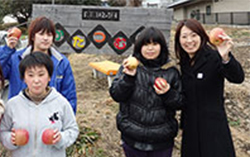
Staff members and users of Katatsumuri who
started apple-cultivation with aids from AAR Japan,
being accompanied by Akiko KATO (Left, AAR Japan).
(January 2015)


8.04.2017

The Great East Japan Earthquake: For those who have no place to go…Opened after clearing the woods

Lavorare Pecore, a type-B support centre for ongoing employment, began its operations on July 29th in the town of Murone, Ichinoseki city, Iwate Prefecture. It is administered by the “Homare no kai” association. Despite the rain, approximately 100 project members and community locals attended the opening ceremony, which was complemented by an elegant harp concert. Lavorare Pecore is a facility surrounded by nature with an extensive area of almost 1 hectare, or 2.45 acres. It was a long and hard road before Lavorare Pecore was able to begin its operations.

Overwhelmingly insufficient number of facilities
The four board members of the “Homare no kai” are all from Kesennuma city and survivors of the Great East Japan Earthquake. They had engaged in supporting people with disabilities for many years. While the four of them worked in a consultation office, they realized that there were not enough places who would receive victims whom had suffered from the earthquake or received abuse by their family members. Many of them had nowhere to go because their conditions did not fulfill the criteria of existing facilities. Thus, the members of “Homare no kai” felt those services were limited. It was then that they were approached by an earthquake survivor who ran a landscaping business. As he was going to close down his business, he offered for them to use his land and house in Murone. The four members all agreed immediately to establish a new place for those who were having difficulties finding a facility.


An image illustrated by Mr. SUGAWARA, a representative of the board who is also a certified landscape designer. In this illustration, he expresses his hope that all residents will live happily and in peace for the rest of their lives.

However, with little funding, the operation hit a rough patch. Having only the four board members to clear the dense woods in the area, as well as restore the house whose floor had fallen through from a leaky roof, was very challenging and made them feel discouraged on many occasions. But, each time they remembered the faces of those who are not accepted by any facility they were motivated to overcome their struggles, finally opening a group home in November, 2016. They were convinced that there were still more needs to be satisfied and came to the decision to launch this support center.
After being referred by Mr. Ryuichi MIURA of Japan Platform, Tohoku office, AAR Japan provided a part of the costs connected to the construction of the building (the photo on the right). AARJ Japan also provided full funding for the plumbing, transportation of the arbor and garden planter, as well as donating the kitchen equipment. All of this was done with the assistance of AEON 1% Club Foundation.
This arbor and garden planter were transported here from the former temporary housing at Hiraishi elementary school. (July 29th, 2017)

For the time being, the plan for the newly opened type B center “Lavorare Pecore” is to prepare dishes with seasonal vegetables and local specialties, herd sheep and cultivate the seedlings of fruits, vegetables and flowers. They also aim to process and sell their wool or fruit products. The members hope that by interacting with animals and plants in nature, the residents and service users will gradually gain emotional stability and improve “their strength to live” in society. Moreover, making good use of their hectare of land (2.45 acres), they are aiming to not only be engaged in farming and produce specialties, but also to expand their business to distribution and sale. A mobile store to extend the outreach of “Lavorare Pecore” products to one-person households, elderly households and people in areas with little access to supermarkets is also being considered.
“Lavorare Pecore” means “a working sheep” in Italian. This is a photo of a farm located on the premises. They are aiming for production, processing, sale and distribution. (July 29th, 2017)

※This activity is operated with the assistance of Aeon 1% Club Foundation.


[Reporter] profile as of the date of the article
Shinichiro OHARA, AAR Japan Sendai office
Ohara joined AAR Japan in August 2011 after working in a manufacturing company. Based in Sendai, he visits affected areas such as Iwate, Miyagi and Fukushima on a daily basis and is engaged in reconstruction assistance. He was born in Sendai, Miyagi Prefecture.


Japanese-English translation by Ms.Yukari Onda
English editing by Ms. Alice Chee

This article has been translated by volunteers as part of the AAR Japan's Volunteer Programme. Their generous contributions allow us to spread our activities and ideas globally, through an ever-growing selection of our reports from the field. 

7.03.2017

Vulnerability Multiplied in Syria—Report on the Survivors of Explosive Devices—

AAR Japan, an international NGO, has conducted assessment on the survivors of the conflict inside Syria and published this report, Vulnerability Multiplied in Syria – Report on the Survivors of Explosive Devices –, which makes 6 proposals.


Assessment for this report was conducted over the course of 2016 in cooperation with a Syrian NGO, Hand in Hand for Syria, which began by identifying patients and former patients of medical facilities in northern Syria and entailed interviews with 2,036 survivors of the conflict including 475 children. The result revealed that the majority, 57%, of the survivors were victims of air strikes, followed by other explosive devices (22%) such as landmines, unexploded ordnance (UXO), and improvised explosive devices (IED). In addition, many of the survivors sustained severe injuries and impairments including amputation, visual and hearing impairments in addition to fractures and wounds, resulting in a high level of dependency in activities of daily life like eating, toilet, washing, and dressing.

Furthermore, given the health care system decimated in the conflict, many of these survivors do not have access to adequate medical care, rehabilitation services, or assistive devices. In addition to the physical and psychological burden on the survivors themselves, in the absence of functioning social welfare system, providing assistance in every step of daily life places an enormous burden on the family members as well, not to mention the significant economic impact in case of severe injuries and impairments of main breadwinners of the household.

Based on these findings, AAR Japan proposes the following to aid organizations working in Syria and donor countries, corporations, and individuals that provide indirect support to humanitarian aid in Syria.

1.    Include provision of rehabilitation services and assistive devices in the intervention in consideration of the conflict survivors;
2.    Help build local capacities, local organizations and volunteers working in Syria, to be able to provide rehabilitation and trauma response through training and financial support;
3.    Enhance food security and livelihood support to those who lost jobs due to injuries and impairments;
4.    Improve referral mechanisms across sectors in order to provide comprehensive support to the injured who are particularly vulnerable;
5.    Conduct awareness raising activities to reduce stigma and combat the loss of dignity particularly by the injured;
6.    Adapt the contents of risk education to reflect the context of the ongoing Syrian conflict to maximize the effect.

6.21.2017

Great East Japan Earthquake: Organizations that Support Voluntary Evacuees

6,000 Evacuees Live in Tokyo

Even though 6 years have passed since the Great East Japan Earthquake, there remain approximately 109,000 individuals requiring assistance, who evacuated their home town as a result of the impact of the earthquake, tsunami, and nuclear accident. Of these, approximately 6,000 evacuees live in Tokyo (Reconstruction Agency, April 28, 2017). AAR Japan (Association for Aid and Relief) has been providing various forms of aid since immediately after the earthquake hit, and recently partnered with Musashino Smile, to begin providing aid to the evacuees who reside in Tokyo. Musashino Smile is an organization represented by Ms. Megumi Okada (picture below), an evacuee who fled from Fukushima city to Tokyo with her children, and is supported by various Tokyo-resident volunteers. On April 28, Musashino Smile hosted a “Yoransho Salon,” an event to encourage evacuees to visit and engage in light conversations over tea (picture to the right). “Yoransho” is a word from Fukushima that means “please stop by.” 16 evacuees from Fukushima and other areas participated in the event to exchange information and share updates.

Yoransho Salon was held at Musashino city, an evacuation destination for many evacuees. Yoransho Salon occurs once a month. (April 28th, 2017)

6.14.2017

Zambia: Supporting the New Life of “Former Refugees”

AAR Japan has conducted relief activities in Zambia since 1984, for 33 years, when a widespread famine in Africa attracted worldwide attention. At the beginning, its support activities in medical, educational, agricultural and other fields were based in Meheba in the North-Western Province where many Angolan refugees sought shelter after fleeing the civil war in their home country. After many refugees returned home following the end of the Angolan Civil War in 2002, AAR Japan moved the base of its subsequent activities to Lusaka, the capital of Zambia and its environs. Since then, it has provided assistance to people who have tested positive for HIV/AIDS, as the issue became a serious problem at that time, and strengthened health services for mothers and children in farming villages where people have little or no access to medical services.

In March 2017, AAR Japan reopened its office in Meheba and launched activities to assist the joint efforts to build a community by the citizens of Zambia and “former refugees” from Angola who decided to settle in Zambia rather than returning to their home country.
Atsushi NAOE of AAR Japan visits households in the site (April 2017)